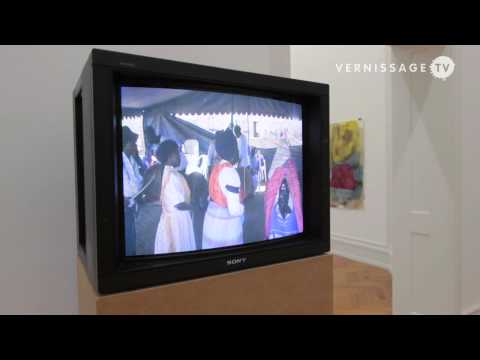
Often times, documentary films about exhibitions exploring a vast body of an artist's multifaceted practice can become an artistic document on it own. Through this series of films, Moshekwa Langa's body of work of intricate drawings, paintings and prints as well as hypnotic video installations is archived and preserved as candidly and honestly as the medium allows.
Moshekwa’s spontaneous and expressive body of work leaves associations to the unfinished, and such is life, and dream terrors and memories as witnessed by entities in transience.
And the selection I compiled based on extensive exhibitions of artist Moshekwa Langa proves exactly that notion that he is an artist who is eternal grappling with exile and dislocations of the mind from the geographies of their origins.
The documentary films investigates the inner workings of Moshekwa’s mind, bringing
together his archive of interdisciplinary experiments in a survey of his practice over
two decades.
And in most of his vibrantly and distinctively coloured works, absurdity and intuition
coexist, they are dimensional spaces where the artists is tackling themes of human
interconnectedness, the individual and community, home and memory, within spaces of dislocation and displacement in an experientially fragmented world.
His unconventional interaction with everyday objects embedded with urgent social debates, challenge traditional modes of perceiving these objects; a manipulated into metaphorical imagery.
Unfolding as a dynamic sequence of interviews interwoven with previous installations, that included video and audio art, Langa’s artistic quest proposes an exploration of how connections are forged within senses of the viewer, pressing societal questions of identity, individuality in a world of collectivised ways of being.
Reflecting on constant shifts in relationships between the individual and their
geographical location, when home is no longer a fixed dwelling but a space where
memory is accumulated and transmitted, Langa prompts us to contemplate the
inevitable consequences of the hybrid identities forged through traces of physical
spaces travelled.
Langa’s fading colours gesture time’s unstoppable trudge through space, mediating
human experience with memory as a slice captured by our enchanted senses; where canvases capture urban landscapes and their many layers, always recurring as a motif for rootlessness, dislocation from familiarity, and as a state of being lost.
Endlessly pursuing experimental practices that employ sculpture, painting, video and sound to investigate the surreality of contemporary life, Moshekwa Aron Langa’s monumental works and installations provide a variety of ways of encountering different accounts of historical, personal and imaginative events.
In other works, however, his use of mineral and organic materials underscore how the notion of living materials can recast mythological messages that seem forgotten by one onto the fore of their minds.
A limited palette of colours - blacks and shades of grey alongside whites, infusion of paper, textile and other found materials speak of an austere language that works in the absence of representations. Scattered about his studio or galleries, one finds large-scale and small- scale collages, sculptures and other artefacts that speak to his longing for home.
And his hometown has played a pivotal motif in his varied experiments, with impacts of
exile on his mind vividly depicted through the obscure figures, spaces and compositions comprised of found materials such as photographs, maps and directories of diverse social data.
When beauty blends with the absurd, then emerges paintings that sensitively
decorate the profound in the mundane. And the artist’s multifaceted narratives
therefore move across media, and return to notions of scathed memory, flawed and
skewed either by urban neurosis or traumatic nostalgia.
There lingers reciprocal connections between objects, memorabilia and his personal
therapies, each work containing threads of interwoven personal observations and
lamentations; works that together provide an appearance that is not passive but
actively constructing perceptions of self that exists in perpetual exile.
In his dreamlike visual and aural compositions, suspended figures float as though frozen in perpetual motion, like ghostly entities swept along streams of consciousness, disparate yet in a shared space of his craft.
Once suppressed faces resurface in collages and geometric forms that populate in
multilayered paintings, sketches and brush strokes that bend edges to curves of
expression that could be non-human.
The selection of works on display throughout the film are not a static containment of
finished imaginative experiences. Here, sculptures become hybrids, where the
sculptural form shaped by unexpected forces and transformations; where the body
and land merge as terrains that can be disfigured and altered.
Langa’s art functions as a tool for self-orientation in a chaotic present, where his
ideas expand on ideas of racialization and move towards an understanding of racial
identity as a specific cultural experience that includes being perceived while being
“othered” within a shared experience of vulnerability (racial or gendered).
His varied histories are brought into renewed contact, establishing new integrative
points of view that are both unsettled and unsettling; excavating traces of how each
body and object’s after-life can be harnessed into the present, each unravelling memory becoming a narrative thread that overlaps and resonates into a possible future.
Displaying dissident thought models not compatible with ideas of a largely rigidglobal canon, Langa has always remained an artist in seclusion, ever introspective and while engaging with urbanism, erasures of identities and consequences of personal loss, focusing on specific locations and their psycho-social architecture.
The documentary films therefore do justice to his notions of placelessness as a location for
disparate minds searching for cohesive memories within a fragmented terrain of
recollections.